Telemetry Technicians are healthcare professionals responsible for continuously monitoring patients’ heart rhythms using specialized telemetry equipment.
HIGH DEMAND
Essential role in every hospital
MAKE AN IMPACT
Support patients when they need it most
REWARDING CAREER
Start a stable career in healthcare
HIGH DEMAND
Essential role in every hospital
MAKE AN IMPACT
Support patients when they need it most
REWARDING CAREER
Start a stable career in healthcare
WHAT IS A
TELEMENTRY TECHNICIAN?
Telemetry Technicians, also referred to as cardiac telemetry technicians, are healthcare professionals who monitor patients’ heart rhythms using specialized telemetry systems and ECG technology.
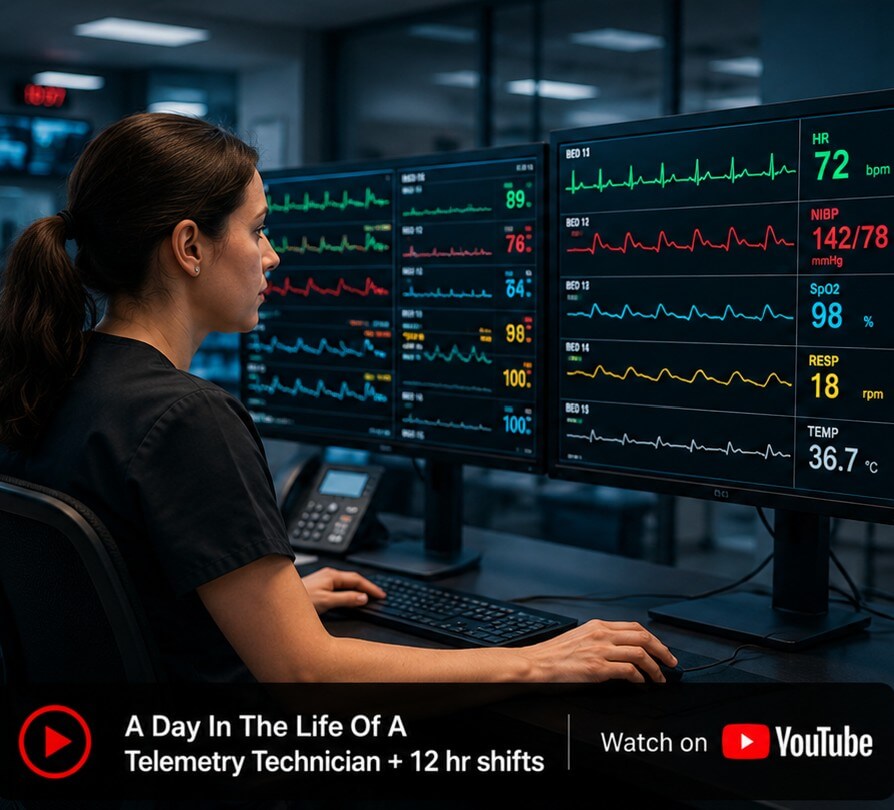
Most of their work involves observing real-time cardiac activity displayed on computer monitors. Telemetry systems continuously collect information about a patient’s heart rhythm and transmit that data to a central monitoring station where technicians can identify abnormalities, arrhythmias, and other significant rhythm changes.
Telemetry Technicians are trained to recognize normal and abnormal cardiac rhythms and communicate important findings to nurses and physicians. While they do not provide direct patient treatment, they play a critical role in helping healthcare teams identify potential cardiac problems early and respond appropriately.
Telemetry Technicians typically work in hospitals and monitor multiple patients simultaneously from a centralized monitoring room or nursing station. Because cardiac monitoring is required around the clock, Telemetry Technicians may work day, evening, night, or weekend shifts depending on the needs of the facility. Workers in this position often report directly to nursing leadership and are an important part of the patient care team.
tELEMETRY Tech Duties
and Responsibilities
Telemetry Technician’s provide advanced ECG monitoring while concentrating on observation of patient status through assessment of ECG strips and arrhythmia interpretation. Telemetry Technician’s recognizes problems through continuous EKG monitoring with accurate interpretation of cardiac rhythms and dysrhythmias and interval measurements; identifies probable causes, and seeks solutions to correct the problem according to established standards. Telemetry Technician’s also appropriately identifies, responds and communicates to direct patient care givers any potentially life-threatening rhythm changes and monitor alarms.
CONTINUOUS TELEMETRY MONITORING
Monitor multiple patients’ cardiac rhythms simultaneously using centralized telemetry monitoring systems. Observe real-time ECG activity and identify abnormal rhythm patterns.
RHYTHM ANALYSIS
Analyze telemetry strips and recognize arrhythmias, conduction abnormalities, and other significant cardiac rhythm changes requiring clinical attention.
COMMUNICATE CRITICAL CHANGES
Promptly notify nurses and physicians when significant rhythm changes, dangerous arrhythmias, or emergency cardiac events are detected.
DOCUMENT & REPORT
Accurately document rhythm interpretations, patient monitoring activities, and significant cardiac events according to facility policies.
MAINTAIN TELEMETRY SYSTEMS
Ensure telemetry monitors, transmitters, leads, and monitoring stations are functioning properly to provide continuous patient surveillance.
IS there jobs available for telemetry technicians?
Find jobs near you
use the links below to see what jobs are available near you. Just type in your city once on the page
Telemetry Technician Job Outlook
According to BLS data, job opportunities for cardiovascular technologists and technicians across specialties is expected to grow 22% by 2034, with a 2026 median salary of $86,000, based on skills and experience. This is a faster growth than the average for all occupations.